
POSITIONAL RONDO 4v2
Before moving on to the explanation of the exercise, it is essential to identify the offensive principles underlying this 4 vs. 2 rondo.
During the possession phase, the goalkeeper was required to take an active role in the build-up, constantly seeking the correct positioning to create numerical superiority over the opponent and thus become a viable outlet for teammates under pressure.
In this phase, the instructions to the team were clear: maintain possession within the central areas of the pitch and avoid shifting the play toward the flanks.
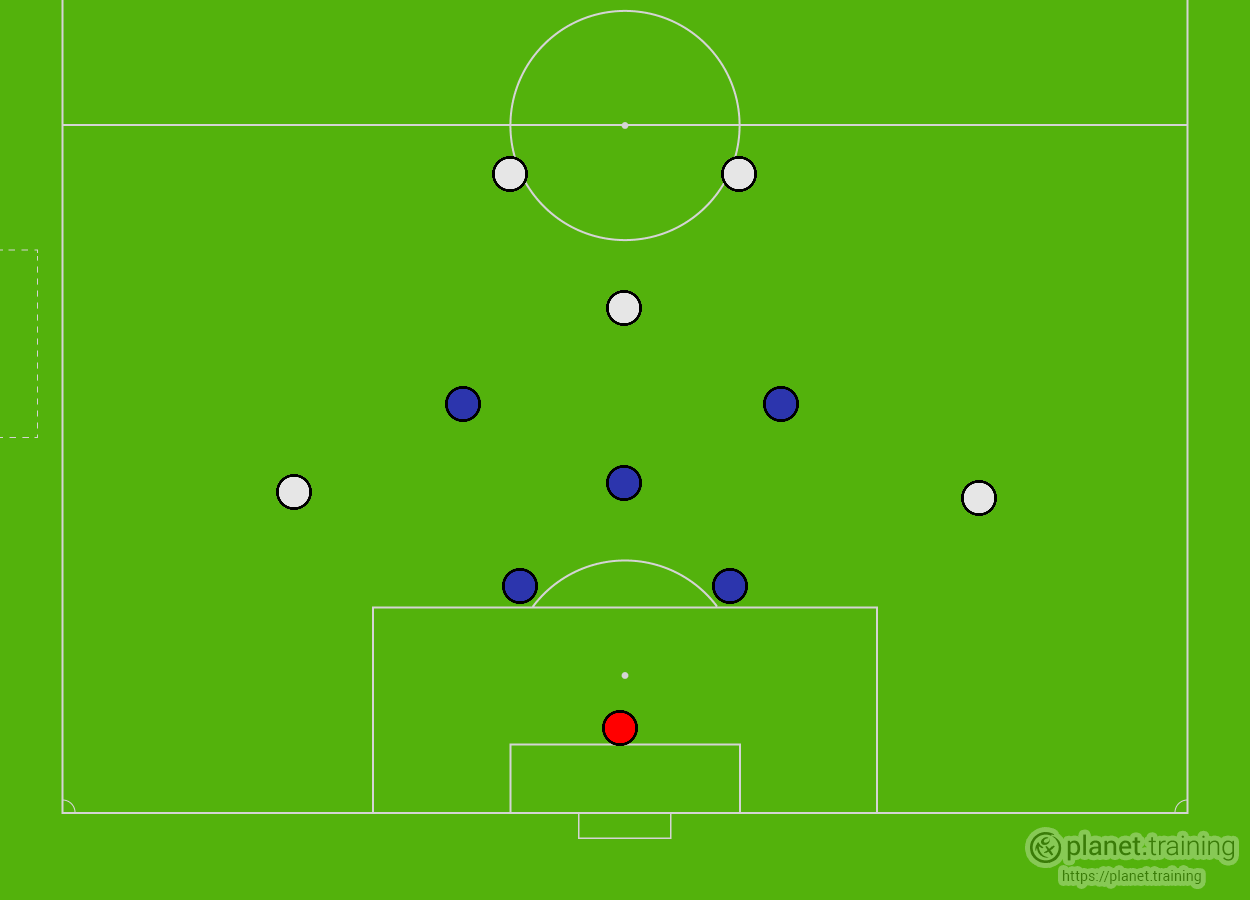
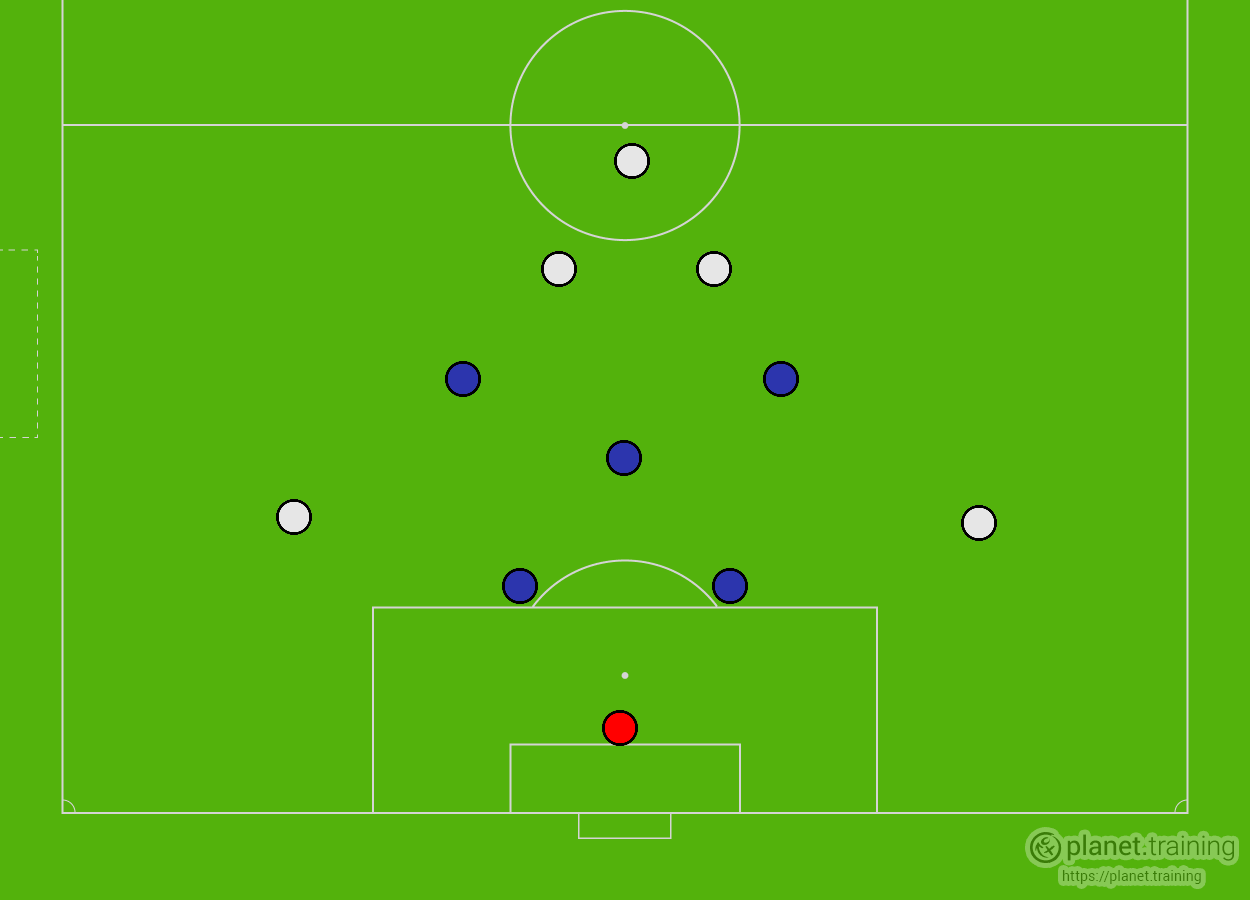
Considering these directives and the tactical systems that were generally employed (1-4-3-1-2, 1-4-3-2-1, or 1-4-3-3), the following conclusions can be drawn when the goalkeeper is in possession of the ball:
1-4-3-1-2
1-4-3-2-1
1-4-3-3
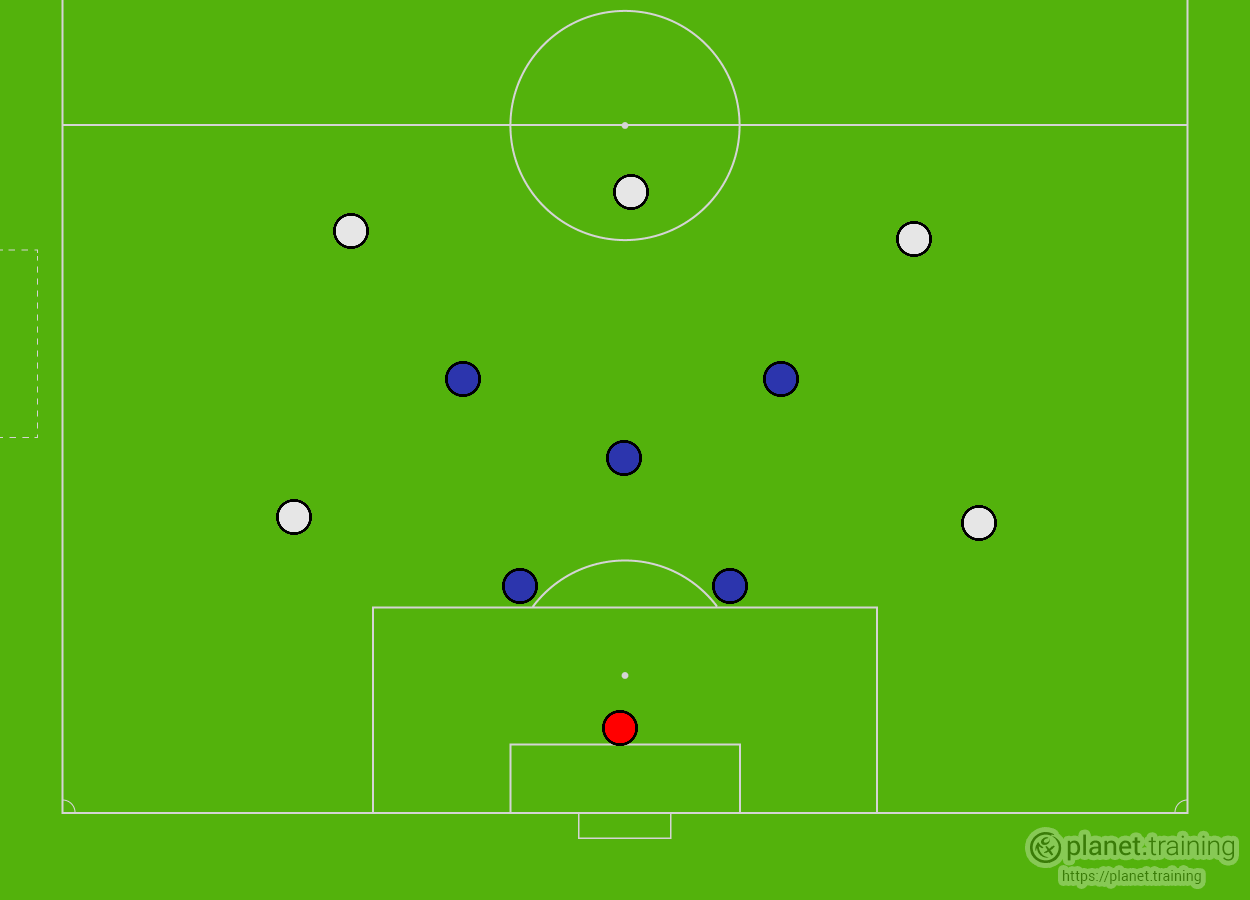
1 -The first option to maintain possession was to play through the center-backs.
2 – If that option was not available, the next solution was to connect with the holding midfielder.
3 – If the holding midfielder could not be reached, the goalkeeper was expected to find one of the interior midfielders.
4 – If none of these options were viable, the ball had to be played long.
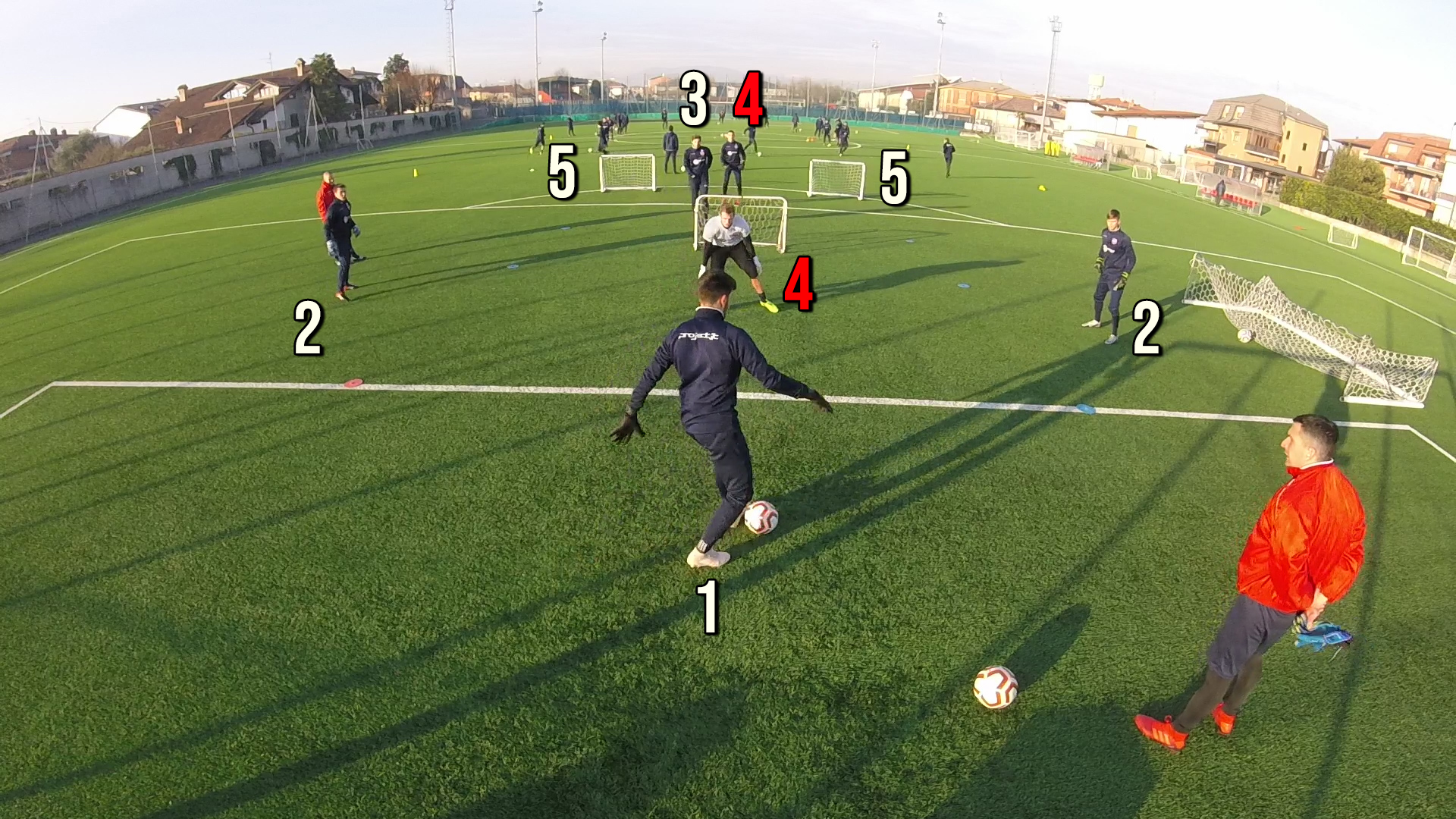
After a warm-up using an analytical training methodology focused on oriented control and pass accuracy with the inside of the foot, the following rondo is introduced (complex methodology). In this exercise, four goalkeepers perform the offensive phase while the other two take on the defensive role.
In the image below, you can see the practical application of the previously mentioned conclusions.
References:
1 – Goalkeeper
2 – Center-backs
3 – Holding midfielder
4 – Goalkeepers performing the defensive phase
5 – Interior midfielders
Exercise Rules
The game is played with a two-touch limit.
Completing 10 passes counts as one goal.
The goalkeepers labeled as “number 4” must defend their respective goals and/or prevent the 10 passes by protecting the area marked with colored cones on the ground.
If goalkeeper “number 1” successfully passes the ball to goalkeeper “number 5” (the holding midfielder), the pass counts double.
Scoring in the central goal counts as one goal.
If goalkeeper “number 1” scores in the “number 5” goals (representing the interior midfielders), the goal is worth three.
The primary objective of the exercise was to help goalkeepers internalise the team’s offensive principles and tactical requirements. To achieve this, they were expected to incorporate the following key aspects:
1 – Be proactive.
2 – Recognise the correct positioning needed to create numerical superiority. This required constant movement, rather than remaining static.
3 – Adopt the appropriate body posture: open and oriented toward the centre of the pitch—not closed or facing directly toward the ball—as this would reduce their field of vision and hinder the analysis of the weak side.
4 – Analyse the weak side (the side opposite to where the ball is located) before signalling to a teammate that they are ready to receive the ball.
5 – Communicate effectively—both verbally and through clear body language.
6 – Identify the correct passing option.
7 – Execute proper technique in oriented control.
8 – Execute proper footwork.
Throughout the exercise, these aspects can be either rewarded or penalised to ensure effective stimulation and learning.
For example, a goalkeeper may be penalised for adopting a closed posture when receiving the ball, or for failing to scan and analyse the weak side beforehand. Additionally, the number of passes required to score a goal, set at 10 in this case, can be reduced to increase the level of difficulty. Doing so forces the goalkeepers in the defensive phase to apply greater pressure and be more aggressive in their attempts to recover the ball.
The ideal progression for this exercise would be to follow it with a full-team possession drill,
allowing the goalkeeper to transfer the concepts trained in isolation into a real game context, reinforcing their integration with the rest of the squad.
IVÁN RIVERA