
DEFENSIVE RONDO
The following exercise was conducted with the first-team goalkeepers of Virtus Ciserano Bergamo 1909, Italy.
This is a Complex task involving the simultaneous participation of four goalkeepers. It takes the form of a rondo, which, beyond its offensive characteristics, is primarily designed to target a broad defensive tactical objective: space coverage.
It is essential to note that this task was developed as a progression from previously acquired concepts, including positioning, movement, stances, identification of various stimuli beyond the ball, game reading, anticipation, ball attack, diving techniques, and 1v1 situations, among others.
DESCRIPTION
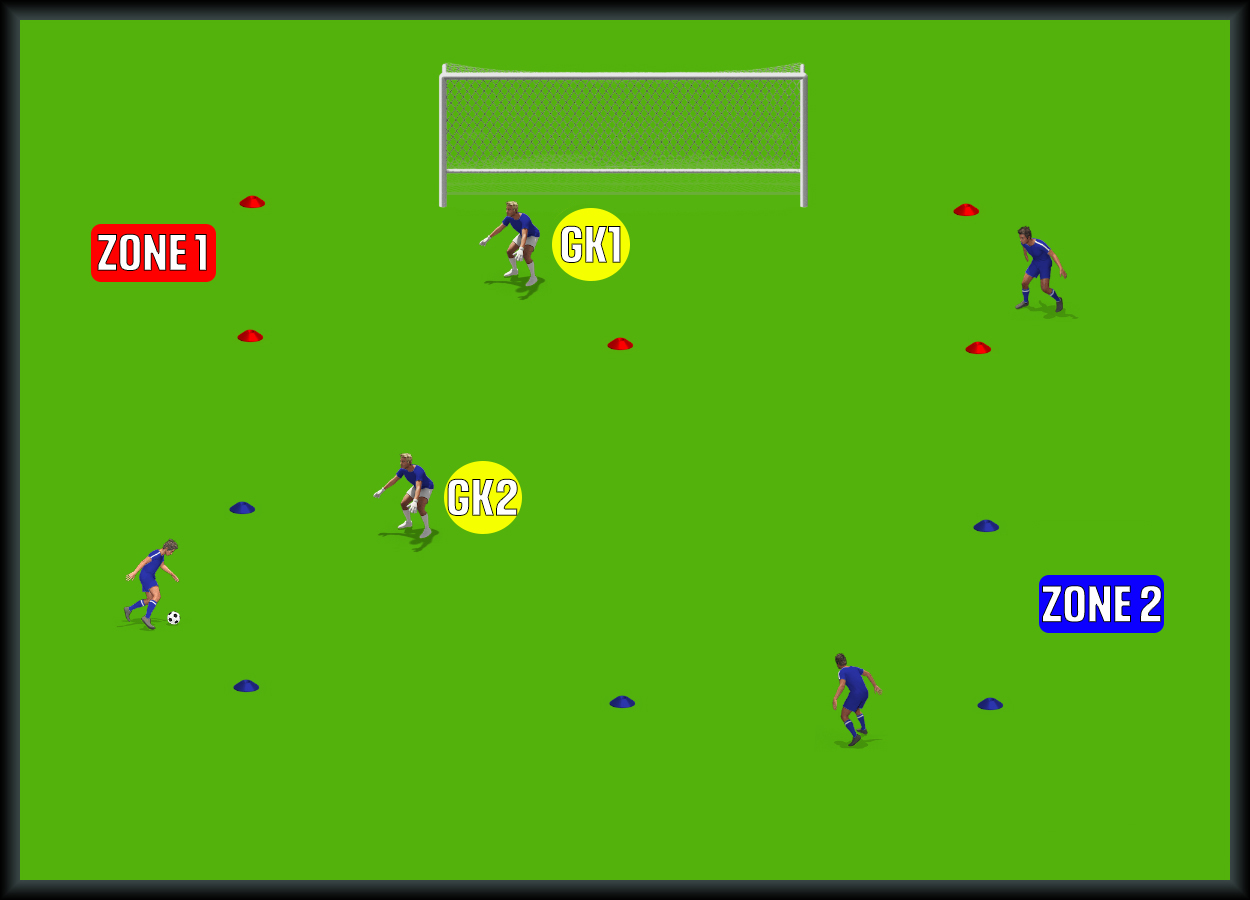
Two zones are marked out: the smaller one (3 m x 6 m), referred to as “Zone 1” and marked with red cones, is defended by goalkeeper “GK1.” The second zone, defined by blue cones (8 m x 6 m), is referred to as “Zone 2” and is defended by goalkeeper “GK2.”
The exercise follows these rules:
- The attacking goalkeepers are allowed a maximum of two touches per possession (control and shot).
- A goal scored into either goal is valid from any area of the field.
- 10 consecutive passes by the attacking team count as one goal.
- A goal scored from within “Zone 1” counts double.
Each goalkeeper accumulates negative points based on the type of goal conceded:
“GK1” receives a point against only when a goal is scored into the goal he defends, while “GK2” is penalised each time the attackers complete 10 passes among themselves.
The various rules outlined in the previous paragraph are primarily aimed at reinforcing the defensive objective. Since 10 passes completed by the attacking goalkeepers count as one goal, “GK2” must adopt an aggressive approach in order to recover possession. On the other hand, the fact that a goal scored from within “Zone 1” counts double forces “GK1” to not only protect the goal but also actively cover that specific area. To do so, he must apply his game reading and situational analysis skills, and, if necessary, anticipate a potential pass into space or intervene in the event of a shot on goal.
Given that the structure of the task is a rondo, the attacking goalkeepers are inherently working on numerous aspects of the offensive phase of goalkeeping: first touch, precision in passing, movement, body posture, positioning to receive a possible pass, communication, identification of the optimal passing option, scanning, and more.
It is worth noting that if goalkeepers defending “Zone 1” experience difficulties in reading diagonal passes into the zone and are unable to effectively cover the space, “Zone 2” can be enlarged while maintaining the original dimensions of the smaller zone. This modification provides the goalkeeper with additional time for better analysis, interpretation, and execution.
Finally, a possible progression of the exercise could be the inclusion of outfield players.
IVÁN RIVERA