THE ROLE OF THE GOALKEEPERS IN THE OFFENSIVE PHASE
To explain the goalkeeper’s specific role in the build-up phase, I find it necessary to first outline some basic concepts that will help clarify what we are asking from the goalkeeper.
First, we distinguish between the concepts of: Game Idea, Game Model, and System of Play.
GAME IDEA
It is the idea that, as a coach, I will bring to any team I work with. It is based on three pillars:
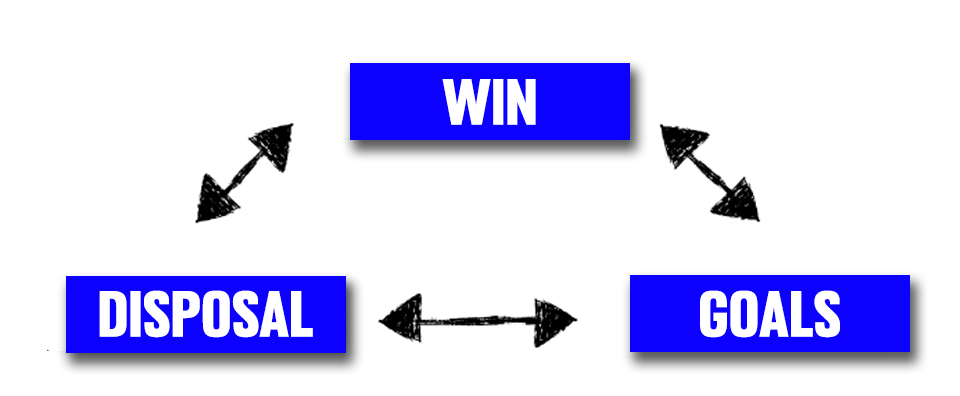
I choose to speak of “disposal” rather than “possession” because I believe that to truly have or hold something, we must do so with our hands. For example, if I want to grab a pen, I will use my hands, not my feet. Translated into the world of sports, one could argue that in rugby or basketball, players can actually “hold” the ball, since they are allowed to handle it with their hands and retain it for a specific amount of time. This concept, however, does not apply to football. In fact, in football we generally manipulate the ball with the same part of the body that we use to move—our feet (with the exception of the goalkeeper).
Therefore, I do not believe it is accurate to speak of “possession” of the ball, because in my view, the ball is always contested, even when it is at the feet of one of my players. The mere fact that we cannot hold it with our hands means that there is always a risk of losing it. When I see possession statistics for two teams, I often wonder how they calculate the time the ball travels from one player to another—during that instant, no one “possesses” it.
Understanding that I “dispose” of the ball rather than “possess” it compels me to develop a much deeper approach to maximising the amount of time we can keep the ball at our disposal. This work is an integral part of the Game Model I will explain in the next section.
Then, we must define why and for what purpose we want to have the ball at our disposal. And here is where we affirm that our commitment is to the sporting result. Therefore, the objective of having the ball is to use it to score goals and maximise our chances of winning. It is also true that if we have the ball at our disposal, the opponent’s chances of scoring against us are reduced. In this way, it becomes a method of defending as well. We attack and defend with the ball.
GAME MODEL AND SYSTEM OF PLAY
The Game Model is built collaboratively with the players, encouraging their active participation through a teaching methodology based on discovery learning (Bruner, n.d.). At the same time, the model takes into account the club’s idiosyncrasies, involving both management and supporters in its development process.
THE GOALKEEPER: THE FIRST FREE MAN
Returning to the Model, if our goal is to maintain control of the ball, the goalkeeper’s involvement becomes essential.
While football often involves unpredictable elements, there is one certainty that helps us begin to shape our model (tactics) or strategy (opponent-oriented): when the referee blows the whistle to start the match, it will be 11v11. Based on this basic premise, we can also assume that it is highly unlikely for the opposing goalkeeper to mark a player. In other words, when we are in control of the ball, we expect their goalkeeper to remain protecting the goal, and the 10 outfield players will be the ones trying to take control away from us.
This gives us an 11v10 numerical superiority. And if we dig a little deeper, in case the opponent doesn’t want to defend man-to-man, they will likely create 2v1 situations somewhere on the pitch (often by adding an extra defender at the back). We can now say that our numerical superiority increases to +2.
Continuing from the previous paragraph, we understand that we must develop a game model that allows us to identify and utilise the free players left by the opponent, to overcome the 10 obstacles (the opposing outfield players) and create a goal-scoring opportunity, and ultimately finish it. As mentioned earlier, this aligns with our core idea: to be in possession of the ball in order to score goals and win matches.
In this context, we can say that when we start the play, the ball is in our goalkeeper’s control. At that moment, it’s clear that we are the ones in control of the ball, not our opponent. If we choose to play a long, frontal pass, the key question becomes: who will have the ball when it lands? That question has no clear answer, and it involves significant risk: if our opponent gains control, they can launch a direct attack with a large amount of open space, since we will have pushed our team upfield for the long ball. That’s why we choose other paths.
Starting from the premise that we dispose of the ball — rather than “possess” it — we must provide the ball carrier with clear and varied passing options to increase the chances of maintaining that disposition and progressing up the field. Therefore, we propose that there should always be three passing options: one to each side of the ball carrier, and one forward through the lines.
Another key point to consider is the concept of Attraction. That is: when we are in control of the ball, we attract. We use the ball as bait to free up other areas (or players), aiming to bypass the opponent and generate a goal-scoring opportunity. We attract through short and fast passes, or by drawing and fixing defenders.
Understanding the concept of attraction is essential, as it gives real meaning to ball disposition. We are always trying to score goals in order to win. We do not seek the disposition of the ball just for the sake of it, or to simply accumulate passes. Of course, we are passionate about what we do, and we enjoy being the team in control of the ball rather than our opponent. But the reason we pursue this approach is that we believe it maximises our chances of winning.
In this sense, we can affirm that when we start the play, the goalkeeper is our first free man — our first numerical superiority. And we aim to carry that superiority forward through the field until we create a goal-scoring opportunity.
We have different types of build-ups, depending on the opponent and the chosen strategy. Sometimes we bring the full-backs deep and place three players inside the box. Other times, we start with four inside the area. We predefine movements for one match or another. But the pattern that always remains the same is that the goalkeeper is the first free man, and must participate in the build-up just as they do in rondos or positional games during the week. Attracting and fixing opponents, just like the rest of their teammates. If the goalkeeper passes the ball without being pressed, we are not taking advantage of that superiority.
In summary, the goalkeeper’s role is to participate in the positional play during build-ups and identify where the free man is, in order to direct the play to that side — understanding that the opponent often makes the decision for us. For example, if the opponent sets up man-to-man, the goalkeeper must recognize this and take advantage of direct and aerial runs that arise from the opponent’s setup.