
A SYSTEMIC APPROACH TO GOALKEEPER TRAINING
With the evolution of football and the increasing demands placed on the goalkeeper position, it is necessary to develop a training method that provides a comprehensive tactical, technical, physical, and psycho-emotional repertoire for the athlete, enabling effective performance within the team’s playing philosophy.
To design a program aligned with the conditioning of these four dimensions of the game, the goalkeeper coach must fully understand the head coach’s game model to deliver all the necessary content and closely replicate the game situations the goalkeeper is likely to face during matches.
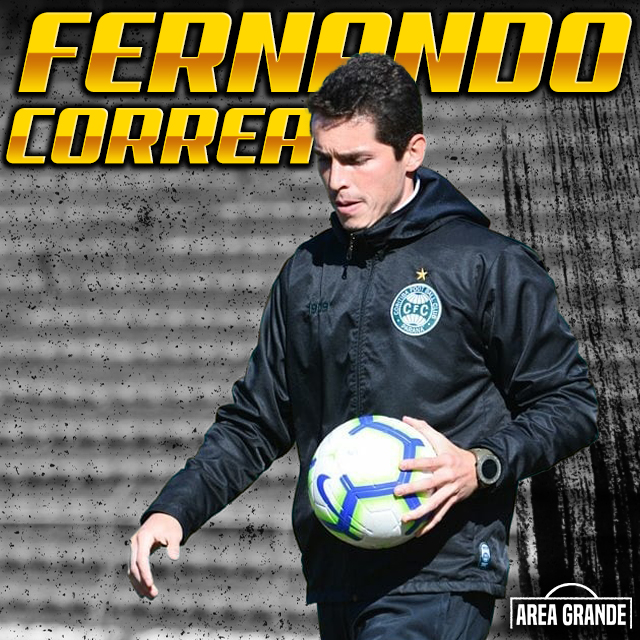
– GOALKEEPER COACH CORITIBA FOOTBALL CLUB (BRASIL)
– TEACHER CBF ACADEMY (CONFEDERACIÓN BRASILEÑA DE FÚTBOL)
– PHYSICAL EDUCATION AND SPORTS TEACHER (UNIVERSIDAD FEDERAL DE JUIZ DE FORA, BRASIL)
– POSTGRADUATE IN LEARNING, DEVELOPMENT AND MOTOR CONTROL (ESTACIÓN DE SA PR, BRASIL)
Building on this concept, the training method employed has been continuously developed and remains in constant evolution, guided by analytical methodology, tactical periodisation, and complex game periodisation—serving as a framework for constructing training microcycles and developing specific exercises.
This method consists of three main components:
- INDIVIDUAL NEED OF ATHLETES
All the necessary physical and technical content is developed for each athlete, including strength, power, core, and mobility training conducted in the gym or an indoor environment. The objective is to prepare the athlete for the demands of on-field training by consistently offering functional exercises that closely relate to the specific actions performed by the goalkeeper.
The technical content focuses on developing the fundamentals of goal protection, aerial space defence, last line defensive protection, and offensive build-up, covering all aspects of footwork fundamentals and positioning.
Every training session begins with work in an indoor environment, followed by a physical-technical warm-up on the field that targets a specific physical capacity and the technical fundamentals most relevant to the upcoming team training session.
AERIAL BALLS WITH OPPOSITION, STARTING FROM DIAGONAL CROSSES AND DEFENDING THE GOAL AGAINST FRONTAL SHOTS, SIMULATING REBOUND BALLS
- COACH'S GAME IDEAS
Understanding the game concepts is extremely important, as it is through them that goalkeepers receive guidance regarding their roles in different phases of the game. Based on this understanding, situational exercises are developed to influence the goalkeepers’ performance during defensive and offensive organisation, transitions, and set-piece situations. These situational drills aim to enhance tactical understanding of the game concepts and reduce decision-making time for problem-solving. Within training sessions, situational exercises represent the highest workload, as they simultaneously address not only game concepts (tactics) but also technical, physical, and psycho-emotional content.
SHOT STOPPING TRAINING AND FRONTAL AND DIAGONAL 1v1 SITUATIONS
- SPECIFIC CHARACTERISTICS OF THE OPPONENTS
During competitive periods, training design incorporates an additional element to consider when preparing the weekly microcycle and specific exercises. Analysing the main characteristics of the opponents is fundamental for developing situational drills that replicate the opponent’s key offensive actions in open play or set-piece scenarios. These exercises are generally conducted one or two days before the match, allowing the goalkeeper to familiarise themselves with the actions they may encounter during competition and avoid being caught off guard.
Based on these concepts, a match preparation cycle is constructed, distributing content throughout the week according to its complexity, physical load, and cognitive demand. Essentially, there are three models of microcycles:
a) When there is no competition, and the main focus is on the individual development of the goalkeepers;
b) With one match at the end of the week, where the primary objective is split between developing game ideas and preparing to face the opponent’s main offensive actions;
c) A third model focuses on the opponent’s offensive actions and allows the athlete to properly recover for the next match, as during this period, there are 2 to 3 matches per week and limited time between games due to travel. In this last case, there is insufficient time for more acquisitive training.
PASS BETWEEN LINES AND NEGATIVE TRANSITIONS
Another important point concerns the goalkeepers who are not playing regularly, as they require adaptations in their weekly training programs to approximate the physical and, primarily, cognitive stimuli received by the starting goalkeeper. These adaptations involve complementary physical training, either indoors or on the field, as well as situational training where decision-making is continuous and the complexity approaches game situations in a segmented manner, but with a higher volume of repetitions.
Finally, it is essential to remember that the training method is influenced by various factors such as the country’s culture, the club’s history and structure, competitive level, individual athlete quality, game philosophy, resources, fanbase, etc. Therefore, the construction of a training method must be based on a systemic perspective, as this is the only way to understand the full complexity involved in implementing a development program. Behind all this, there is not only science in goalkeeper training but also a degree of subjectivity that transforms our practice into an art.
FERNANDO CORREA JUNIOR