
INTRODUCTION TO ISOLATED GOALKEEPER TRAINING
It is necessary to provide context before explaining the following drill.
Malta, 2018. I was about to embark on a new experience: training the goalkeepers of the senior team of Floriana F.C., a Premier League club in Malta, under the management of Nicolás Chiesa.
We began pre-season in July under intense heat. After the first two days, which were dedicated to physical tests and some progressive load adaptation exercises, it was time to start incorporating position-specific drills, where the goalkeepers would begin executing the technical actions inherent to the role.
Being a new coach for the goalkeepers, I felt it was important to design a session that was not only engaging and enjoyable, but also aligned with the main objective: an introduction to isolated goalkeeper training.
EXERCISE EXPLANATION
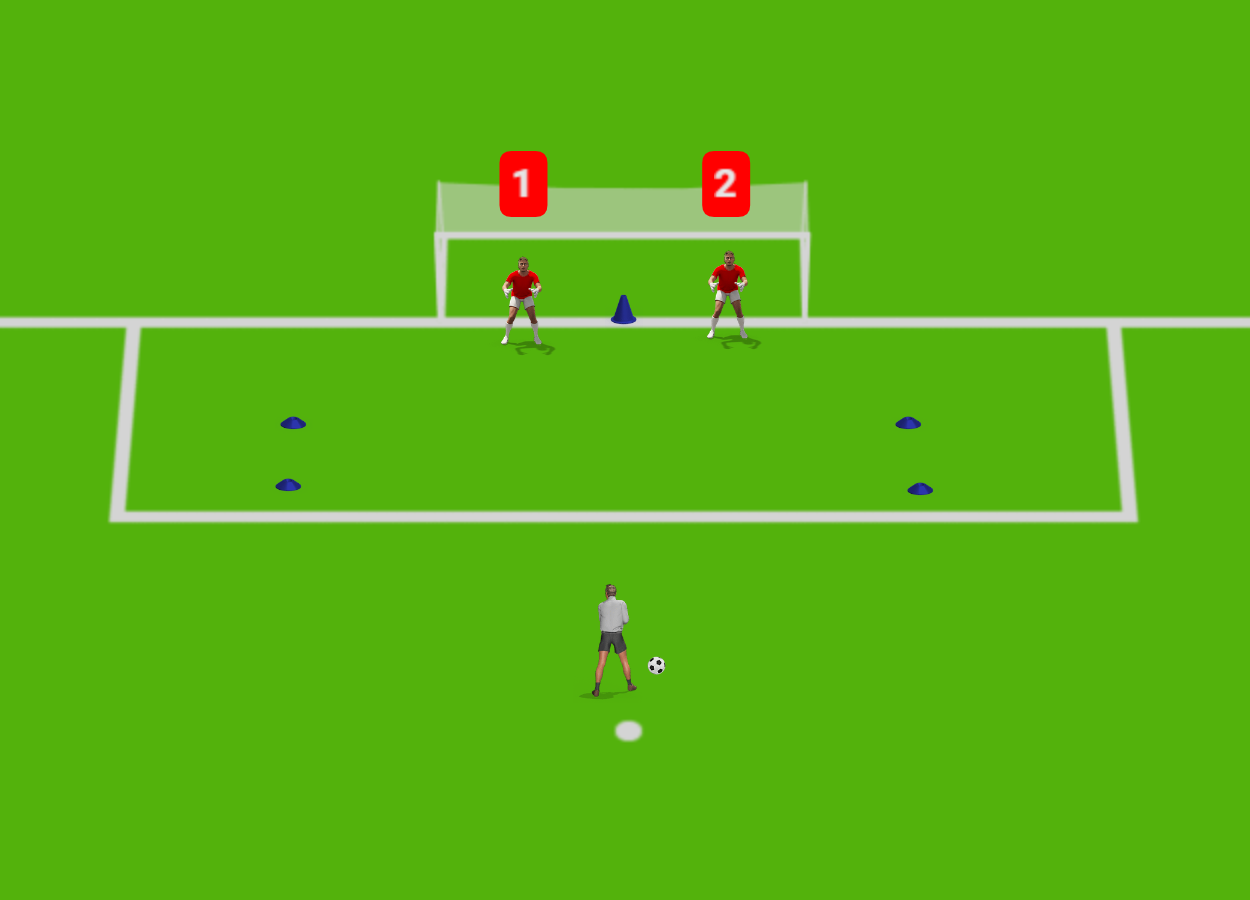
The goal is divided into two halves by a blue cone. Each goalkeeper is responsible for defending their assigned half.
The four blue markers on the ground define two small goals.
Each goalkeeper is identified by a number: 1 or 2.
1st Variation: The coach and the goalkeepers play one-touch passes. The goalkeepers are not allowed to pass to each other; they must always play directly with the coach. At any moment, the coach may choose to shoot at either goal, and the corresponding goalkeeper must react and attempt to stop the shot.
2nd Variation: The coach now has the option to attempt to score in the small goals. The designated goalkeeper must intervene, following an auditory cue — the coach calls out either number 1 or 2.
3rd Variation: An additional auditory command is introduced: “switch.” Upon hearing this command, the goalkeepers must quickly switch the goal they are defending.
The outcome was more than satisfactory.
It is important to note that monitoring the physical load of each repetition was essential. Although the original plan was to perform each set for one minute, if I observed that the goalkeepers were fatigued or short of breath before the time was up, I would stop the drill to allow for recovery and hydration.
IVÁN RIVERA